English
  Español
  português
  Ελλάδα
  Malay
Malay  Nederland

Jul 02, 2026

A partially enclosed lifeboat is designed to provide optimal protection and efficiency during emergency evacuations at sea. Its construction combines strength, stability, and accessibility, making it one of the most reliable lifesaving solutions for modern vessels. The design features a covered upper structure that shields passengers from wind, waves, and rain while maintaining partial exposure for ventilation and easy communication with the outside. The hull is built with durable, corrosion-resistant materials to withstand harsh marine environments. Inside, ergonomic seating arrangements ensure that each person has a secure and comfortable position, while safety belts and easy-access doors simplify boarding and evacuation. The propulsion system, typically powered by an independent diesel engine, allows the lifeboat to maneuver swiftly away from danger zones such as oil rigs or ships in distress. This combination of protective structure and practical design enables the partially enclosed lifeboat to meet international safety standards while maximizing efficiency in real-world rescue operations.
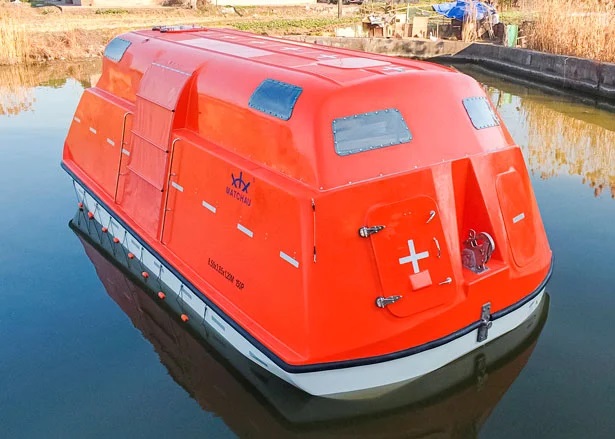
In an emergency, every second counts, and the partially enclosed lifeboat plays a crucial role in accelerating the evacuation process. Its quick-release mechanism allows for fast deployment from a ship or offshore platform, ensuring that passengers can board and launch the lifeboat in minimal time. The lifeboat's lightweight yet reinforced structure ensures smooth descent and water entry, reducing shock impact and maintaining stability upon contact with the sea surface. Once deployed, the lifeboat's self-righting capability and buoyant design prevent capsizing even under extreme weather conditions. Furthermore, its onboard steering and navigation systems enable quick maneuvering away from hazardous areas, ensuring the safety of all onboard. The arrangement of seating and access doors is engineered for efficiency, enabling rapid loading without congestion. This emphasis on operational speed and safety makes the partially enclosed lifeboat a vital component of any emergency evacuation plan.
The partially enclosed lifeboat is not only about safety but also about accommodating as many people as possible while ensuring their comfort during emergencies. Depending on the vessel's type and size, these lifeboats can hold a significant number of passengers—often ranging from 50 to over 150 individuals—while still providing sufficient personal space and safety harnesses for each occupant. The enclosed structure helps protect evacuees from exposure to cold winds, seawater, and rain during prolonged rescues. The ventilation openings maintain air circulation to prevent discomfort or suffocation, even when fully occupied. Additionally, built-in storage compartments provide access to essential survival equipment such as food, water, and medical supplies. The design focus on passenger safety and comfort ensures that the partially enclosed lifeboat supports both short-term survival and longer-term endurance at sea.
Modern vessels, including cargo ships, oil tankers, and offshore platforms, rely heavily on partially enclosed lifeboats due to their balance between protection and accessibility. In scenarios involving fire, explosion, or capsizing, these lifeboats can be launched quickly and safely, offering partial shielding that prevents heat exposure while still allowing effective ventilation. Compared to fully enclosed lifeboats, the partially enclosed type offers easier inspection, faster boarding, and greater visibility, which can be vital in search and rescue operations. Their compatibility with various davit systems and automatic release hooks allows them to be fitted seamlessly across different ship designs, ensuring they are a universal solution for marine evacuation. The adaptability of the partially enclosed lifeboat also means it can be used for both passenger ships and industrial vessels, maintaining efficiency under different maritime conditions.
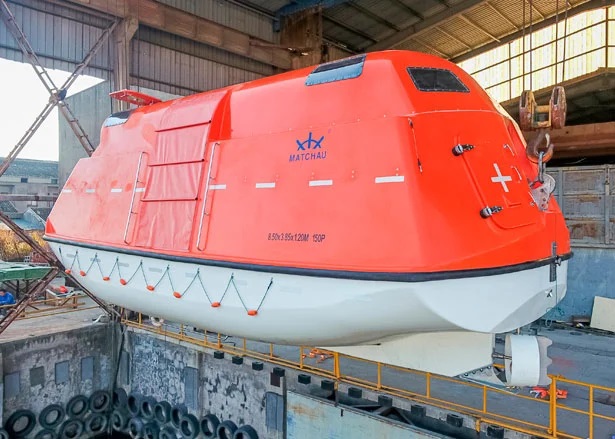
For a partially enclosed lifeboat to perform effectively during an emergency, regular maintenance and inspection are essential. Marine environments expose all equipment to salt, moisture, and UV radiation, which can affect performance if left unchecked. Therefore, lifeboats are built from materials that resist corrosion, ensuring long-term durability. Routine checks include engine testing, release mechanism inspections, and verification of onboard emergency supplies. The ease of access to mechanical components in a partially enclosed design simplifies maintenance, allowing crews to perform regular testing without complex disassembly. This constant state of readiness ensures that the lifeboat will function flawlessly when deployed, reinforcing its role as a dependable life-saving asset on any vessel.
As a premier supplier, Matchau provides critical lifesaving systems including the partially enclosed lifeboat and fully enclosed lifeboat for sale. With decades of expertise, we support vessels with reliable, compliant equipment. We welcome all related inquiries. Please contact us for solutions tailored to your operational safety needs.